
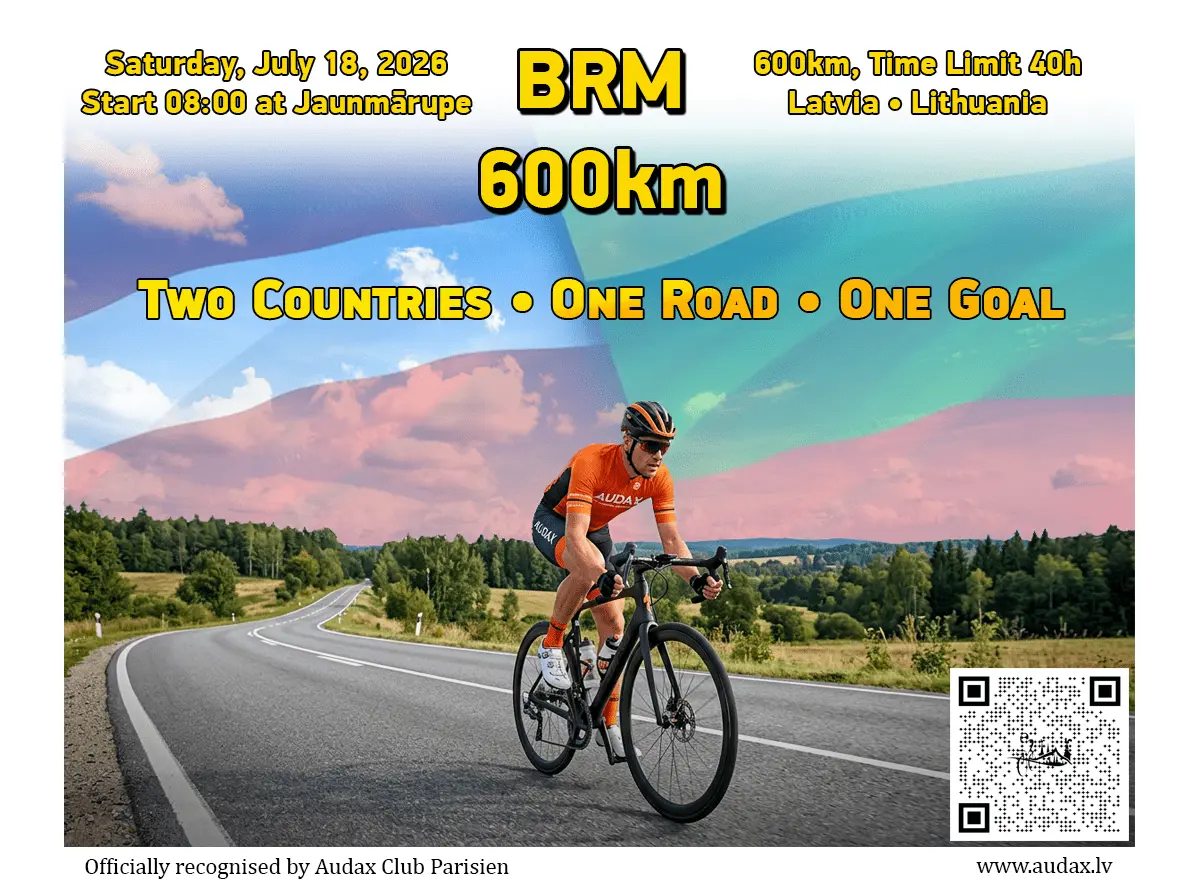
BRM600 Pasvalys [LV] [LT]
600km
ACP Certified
Past
Multi-Day
Event Overview
Rider Requirements & Safety
Self-Supported Ride
This is a self-supported ride with no vehicle support. Participants must be confident in completing the ride independently. The organizers do not provide technical assistance during the ride or for withdrawals.
Participants can help each other, but official support is not provided.
Mandatory Equipment
- Helmet - mandatory at all times
- Front light - working and visible
- Rear light - working and visible
- High Visibility gillet/vest - must be worn
Route Adherence
Strict route adherence is required. Deviation from the route is not allowed. If you must deviate (for shops, technical issues, etc.), you must return to the route at the same point where you left.
Traffic Rules
The brevet takes place in regular traffic. Roads are NOT closed. All Road Traffic Regulations must be observed. Extra caution is required:
- In areas of heavy traffic
- In cities and urban areas
- When turning or entering roads
- At intersections and roundabouts
Checklist (600km)
600 km checklist
kg
All-up weight (bike + checked kit): 0 kg
Mental Preparation (600km)
Mental preparation is just as important as physical training for long-distance cycling. Here are specific strategies to help you succeed in your 600km brevet.
Mindset for 600km
The 600km brevet is a true mental marathon. You'll experience multiple nights, extreme fatigue, and profound self-doubt. Preparation is essential.
Multi-Night Strategy
You'll experience two nights on the bike. The second night is exponentially harder mentally. Plan for it: strategic sleep at a control point (2-3 hours), warm food, and a change of clothes can reset your mental state.
Survival Mode Mindset
At some point, you'll enter "survival mode." Your only job is to keep moving forward, no matter how slow. Speed doesn't matter—forward progress does. Embrace this simplified goal.
Dealing with Hallucinations
Sleep deprivation can cause visual and auditory hallucinations. Expect shadows that look like people, animals, or obstacles. Use a technique: blink twice, look away, then look back. Most hallucinations disappear.
Crew Support Mentally
Arrange for a support person to call you during the hardest hours (2-5 AM). Hearing a familiar voice can be transformative. Have them remind you why you started.
The 80% Rule
When you're 80% done (around 480km), you'll feel like you can't continue. This is the final mental test. Remember: the finish is closer than the start. Count down kilometers, not up.
Post-Ride Planning
During difficult moments, plan your post-ride celebration. What will you eat? Who will you call? Where will you sleep? This future-focused thinking provides mental escape.
Remember: Your body can handle more than your mind believes. When you think you're done, you're only 40% done mentally. The finish line exists — keep moving toward it.
"The body achieves what the mind believes." — Anonymous Randonneur
Estimated Arrival Times
Plan your pace based on these estimated arrival times. Choose the category that best matches your expected riding speed.
Fast (28-32 km/h)
30 km/h average
Total estimated time: 20h 50m
1
🇱🇻 Jaunjelgava - mini top veikals
(95.0 km leg / 95.0 km total)
Estimated arrival:
Day 1 11:10
Checkpoint closes:
Day 1 14:20
✓ Good pace - 3.2h buffer
🚴 This leg: 3h 10m
☕ Stop: 8m
📊 Cumulative: 3h 10m
2
🇱🇻 Jēkabpils - petrol station VIADA
(57.0 km leg / 152.0 km total)
Estimated arrival:
Day 1 13:12
Checkpoint closes:
Day 1 18:08
✓ Excellent - 4.9h buffer
🚴 This leg: 1h 54m
☕ Stop: 8m
📊 Cumulative: 5h 12m
3
🇱🇹 Biržai - coast
(158.0 km leg / 310.0 km total)
Estimated arrival:
Day 1 18:36
Checkpoint closes:
Day 2 05:39
✓ Excellent - 11.1h buffer
🚴 This leg: 5h 16m
☕ Stop: 8m
📊 Cumulative: 10h 36m
4
🇱🇹 Pasvalys - guest house
(34.0 km leg / 344.0 km total)
Estimated arrival:
Day 1 19:52
Checkpoint closes:
Day 2 06:56
✓ Excellent - 11.1h buffer
🚴 This leg: 1h 8m
☕ Stop: 8m
📊 Cumulative: 11h 52m
5
🇱🇻 Tērvete - petrol station ASTARTA
(112.0 km leg / 456.0 km total)
Estimated arrival:
Day 1 23:44
Checkpoint closes:
Day 2 14:24
✓ Excellent - 14.7h buffer
🚴 This leg: 3h 44m
☕ Stop: 8m
📊 Cumulative: 15h 44m
6
🇱🇻 Tukums - petrol station ASTARTA
(67.0 km leg / 523.0 km total)
Estimated arrival:
Day 2 02:06
Checkpoint closes:
Day 2 18:52
✓ Excellent - 16.8h buffer
🚴 This leg: 2h 14m
☕ Stop: 8m
📊 Cumulative: 18h 6m
7
🇱🇻 Jaunmarupe - car park
(78.0 km leg / 601.0 km total)
Estimated arrival:
Day 2 04:50
Checkpoint closes:
Mon 00:00
✓ Excellent - 19.2h buffer
🚴 This leg: 2h 36m
📊 Cumulative: 20h 50m
🏁
FINISH LINE
Estimated finish:
04:50
🏆 Total riding time: 20h 50m
Notes:
- Times are estimates based on average speed and include brief stops at checkpoints
- Leg distances show the distance between consecutive checkpoints
- Actual times may vary based on fitness, weather conditions, mechanical issues, and actual stop duration
- Plan to arrive at each checkpoint at least 30 minutes before closing to account for unexpected delays
- Checkpoint closing times are strict - arriving after closing may result in disqualification
Checkpoint Details
Start
Jaunmārupe
Mazcenu aleja 35 - Car Park
Bag drop: bags can be left here before the ride starts
1
Checkpoint 1
🇱🇻 Jaunjelgava - mini top veikals
2
Checkpoint 2
🇱🇻 Jēkabpils - petrol station VIADA
57.0 km from previous checkpoint
Opens12:28Jul 18 Closes18:08Jul 18
WC
Shop
eBrevet for cyclists to register times.
3
Checkpoint 3
🇱🇹 Biržai - coast
158.0 km from previous checkpoint
Opens18:18Jul 18 Closes05:39Jul 19
eBrevet for cyclists to register times.
4
Checkpoint 4
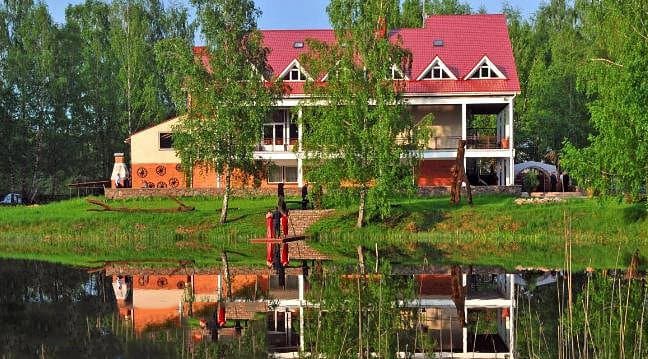
🇱🇹 Pasvalys - guest house
34.0 km from previous checkpoint
Opens18:22Jul 18 Closes06:56Jul 19
Water
WC
Shower
Bananas
Snacks
Hot soup
Drinks
Brevet register
First aid
Bag drop: collection available here
eBrevet for cyclists to register times.
Guest house room, Bathroom with shower, Clean towels and fresh bed linen, Hot soup with meat, cheese, vegetables, Unlimited tea, coffee, water
5
Checkpoint 5
🇱🇻 Tērvete - petrol station ASTARTA
112.0 km from previous checkpoint
Opens21:52Jul 18 Closes14:24Jul 19
WC
Shop
Cafe
eBrevet for cyclists to register times.
6
Checkpoint 6
🇱🇻 Tukums - petrol station ASTARTA
67.0 km from previous checkpoint
Opens23:58Jul 18 Closes18:52Jul 19
WC
Shop
Bananas
eBrevet for cyclists to register times.
Finish
🇱🇻 Jaunmarupe - car park
78.0 km from previous checkpoint
Opens02:22Jul 19 Closes00:00Jul 20
Water
Bananas
Brevet register
First aid
Bag drop: collection available here
eBrevet for cyclists to register times.
Participant List (14)
| # | Name | Gender | Birth | City | Team/Club | Brevet Medal |
|---|---|---|---|---|---|---|
| 1 | Sergejs Zaharenko | ♂ Male | 1982 | Baloži | 🏅 Yes | |
| 2 | Nils Cērpiņš | ♂ Male | 1994 | Jūrmala | — | |
| 3 | Romāns Vasiļjevs | ♂ Male | 1983 | Piņķi | 🏅 Yes | |
| 4 | Dmitrijs Sļepakovs | ♂ Male | 1983 | Rīga | DSTranslate | 🏅 Yes |
| 5 | Eduards Sevostjanovs | ♂ Male | 1988 | Rīga | Kaplis Pro Cycling | — |
| 6 | Leons Pavlovskis | ♂ Male | 1981 | Rīga | 🏅 Yes | |
| 7 | Roberts Fimbauers | ♂ Male | 1993 | Rīga | Ģeogrāfu Mafija | 🏅 Yes |
| 8 | Igors Radions | ♂ Male | 1991 | Mārupe | 🏅 Yes | |
| 9 | Vitalijus Dziuvenis | ♂ Male | 1976 | Staniūnai | Audax Randonneurs Lietuva | 🏅 Yes |
| 10 | Armands Apeins | ♂ Male | 1981 | Rīga | 🏅 Yes | |
| 11 | Vladimirs Sadovņikovs | ♂ Male | 1998 | Rīga | Velokurjers | 🏅 Yes |
| 12 | Sergejs Komarovs | ♂ Male | 1965 | Rīga | — | |
| 13 | Edgars Vizulis | ♂ Male | 1987 | Ikšķile | — | |
| 14 | Anita Dārziņa | ♀ Female | 1978 | Rīga | Latvian Cycling Girls | — |
Gender
♂ 13
♀ 1
Birth Range
1965
–
1998
Top Cities
Rīga (8)
Baloži (1)
Jūrmala (1)
Most born
1980ss
7 riders
Training for this brevet?
Share your preparation on Strava with #AudaxLV and connect with fellow riders!
You can also create your own training, to ride with other riders, with us absolutely for free.
7 Comments
Leave a Reply
You must be logged in to post a comment.

✓ Photos available at https://audax.lv/audax-latvia-event-photos/
✓ Results available at https://audax.lv/results/brm600-pasvalys-2026-results/
✓ Extra checkpoint (Biržai – coast [LT] 310km) has been added. GPX file (.fit) updated.
✓ CP google map links have just been added to this event.
✓ GPX file (.fit) has just been added to this event..
📢 Important Notice Regarding Entry Fee
We want to be transparent about the entry fee for this year’s BRM600. While our standard brevet price is typically €25, the fee for this event is €65. This increase reflects the inclusion of guest house services — specifically, we have arranged comfortable overnight accommodation and rest facilities (including meals) at the turnaround point to ensure riders have a safe and secure place to recharge mid-ride. This added logistical support is intended to enhance your experience and safety on this challenging 600km journey.
✓ BRM600 ride just been updated.